
What Is Jewelry Engraving? A Beginner's Guide to Engraving Your Own Jewelry

[Image by The Glorious Studio on Pexels.]
Jewelry engraving provides you with beautiful, personalized pieces that you (or your loved ones) can treasure for years to come. Engraving pens have made this hobby so much more accessible than it used to be. You no longer need to visit a jeweler or pay thousands of dollars for an engraving machine – you can craft pieces right from the comfort of your own home.
Our beginner's guide to engraving your own jewelry will take you through everything, from what it is to how to get started.
What Is Jewelry Engraving?
Jewelry engraving is a way to turn something like a necklace or a ring into a piece that's even more meaningful and personal. It's the process of cutting a design directly into metal (such as gold and silver), glass, or other surfaces. Jewelry engraving is not the same as printing or plating, where a design sits on top of a surface; engraving creates a groove that you can see and feel. This is what makes an engraved wedding band or pendant so timeless and long-lasting.
The History of Jewelry Engraving
Engraving isn't new. It's one of the oldest techniques for decorating in existence, with origins that go back all the way to before homo sapiens even existed. From then on, ancient goldsmiths would carve patterns and symbols into metal by hand using a tool known as a graver (a specialized hand chisel). The engraver would clamp a piece of jewelry in place and guide a graver along a pencil line letter by letter. Engraving also flourished in the Renaissance period, transforming this craft into a fine art form.
Technology started to evolve, and the machine engraver was developed across the 19th and 20th centuries, which sped up the engraving process. After that came laser engraving, which uses a laser beam to cut into the surface.
Engravers still use all three methods today.
Why Is Jewelry Engraving So Popular?
There are many reasons why someone may want to engrave a piece of jewelry. A lot of the time, a piece is engraved to turn it into something even more special. For example, you may wish to engrave a wedding date inside a ring or your child's name on a pendant.
Popular choices include:
- Initials
- Coordinates of a meaningful location
- A birth date
- A personal message
When it comes to gifting, engraving a piece of jewelry shows the receiver that you truly care. You haven't swiped it off a shelf or picked the first pair of earrings you saw in a catalog; instead, you've put thought and meaning into the gift.

[Image by Arif khan on Pexels.]
What Jewelry and Materials Can Be Engraved?
Some materials lend themselves better to jewelry engraving. Knowing which ones are best will help you create a beautiful piece with a personal touch.
The Best Materials for Engraving
- Precious metals such as gold, silver (specifically sterling), and platinum. These materials cut cleanly and last for years to come.
- Stainless steel and titanium. They are tougher and more budget-friendly, making them popular for everyday pieces and a good choice for beginners.
- Aluminum. This material is soft, which makes it a great pick if you're still building your confidence with an engraving tool.
- Metal-free materials. This includes glass, wood, leather, and acrylic.
Materials to Stay Away From When Engraving
You'll want to stay away from gold-plated and silver-plated jewelry. This is because engraving will cut through the thin layer of the metal on the jewelry surface and expose the base metal that's underneath. If this happens, your piece of jewelry is ruined.
We also recommend staying away from thinner or more delicate pieces, as the pressure needed to engrave can bend the jewelry. Additionally, don't engrave hollow pieces, as this can cause them to crack.
A Quick Test: If you have a specific piece you're not sure can be engraved, try testing your technique on a scrap of the same material. This will show you how the metal responds before you accidentally end up damaging a beloved piece.
Tools You Need to Engrave Jewelry at Home
It's easy to start engraving jewelry at home. You don't need an expensive laser machine or a jeweler's bench to get started. If you're trying rotary engraving, all you need are a handful of tools for multiple projects.
An Engraving Pen
An engraving pen is a small motorized tool you can use to engrave jewelry. A good engraving pen will fit nicely and comfortably into your hand like a traditional pen, giving you a way to carve intricate designs or simple messages into a range of surfaces. You don't need expensive design software, a laser engraving machine, or months of practice before you get a result you're proud of.
The Resparked Engraving Pen is a good example of what to look for in a valuable and trustworthy tool. With its three-speed motor that runs at 8,000 — 21,000 RPM, you can find a speed that works for you. You can charge the pen with a USB-C cable, which means you don't have to constantly replace the batteries.
If you're comparing options online, it's worth reading how to tell if an engraving tool is legit before you buy.
Other Supplies
The engraving pen is the main tool you need, but there are a few other supplies that make the engraving process much smoother.
- Carving Bits - If you're planning to work on different materials, we recommend purchasing a bits bundle that has everything you need. Alternatively, we recommend diamond bits for glass, metal, and stone, and wood carving bits if you're engraving wooden jewelry.
- Stencils - Engraving templates can make all the difference when it comes to creating a clean, intricate design.
- Basic Safety Gear - When engraving jewelry, you at least need a pair of safety goggles and a dust mask. A non-slip cutting mat or a clamp can also stop the piece shifting while you're in the middle of engraving, which means there's less chance of accidents. We recommend purchasing an engraver's safety kit, as this will cover all bases.
- Practice Materials - Before you start engraving directly on the jewelry surface, it's always best to practice on a few scrap materials. This will help you get comfortable with the speed and pressure before you engrave the real thing.
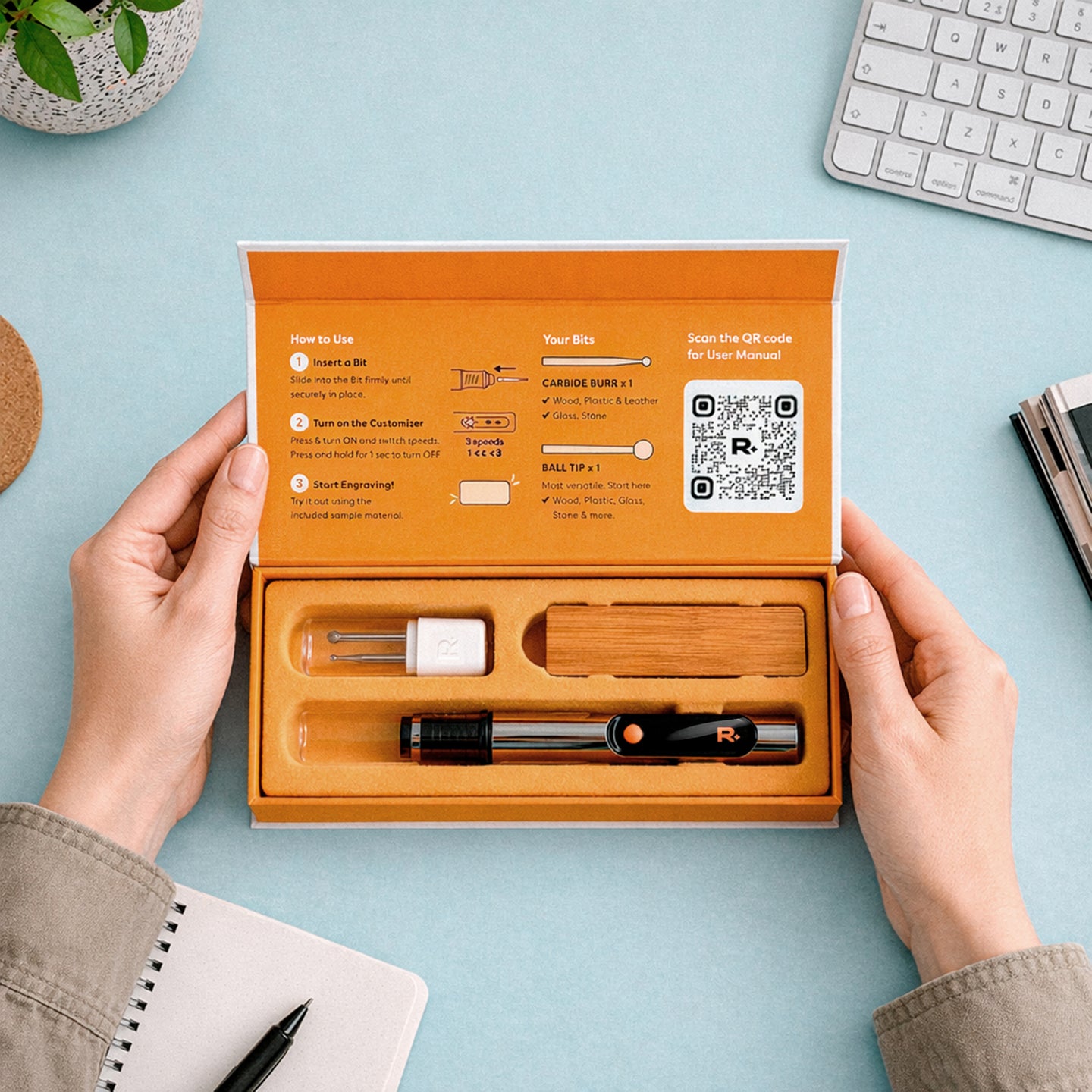
Customizer™ Engraving Pen
Beginner-friendly and trusted by serious makers
Shop NowHow to Engrave Jewelry With an Engraving Pen: Step-by-Step
Here's how to engrave jewelry with a pen from start to finish.
Step 1 — Prepare Your Design
Once you have the jewelry you want to engrave on, you need to start by sketching your design. The pen you use is important - if you sketch directly onto a metal jewelry surface with an everyday pen, it will likely smudge. Invest in a super fine-tip pen that won't smudge. If you don't want to freehand your design, use a stencil to trace the outline onto the surface of the jewelry.
Tip - If you're a beginner, don't start with intricate patterns or complex designs. Instead, we recommend going with something simple like initials.
Step 2 — Make Sure the Piece is Secure
Once you've added your design, place the jewelry on a non-slip mat or hold it in a small clamp or vise. If you try to engrave the jewelry while it's in your hand, you're likely to slip, which can ruin the design and cause an accident.
If you're working on a ring, use a ring clamp or some putty to stop it from rolling away while you work.
Step 3 — Choose Your Bit and Speed
You need to match the bit to the material. The best one for you will depend on the finish you want. Diamond bits will grind metal, glass, and stone. Carbide burrs also work for soft metals like gold and silver, as they shave away metal ribbons from the piece.
Before you start on the real piece, test your bit and speed on a practice canvas.
Step 4 — Engrave the Design
Hold the pen the way you'd hold a regular pen, at a slight angle, and relax. You'll want to let the tool do the cutting rather than pressing down hard on the metal. This will reduce tool wear over time and mean you're less likely to make a mistake.
Work with a light hand and slowly build up the required depth gradually instead of trying to cut deep on the first stroke.
Tip - You don't have to engrave the piece all at once. If you're engraving text or longer and more complex designs, take a short break between letters to keep your hand steady.
Step 5 — Clean and Finish
Once you're done engraving your piece, wipe away any dust or metal residue with a damp cloth.
If you want more of a contrast, you can darken the engraved lines with a permanent marker or a patina solution. Then, wipe the surface clean so the color only stays in the grooves. Taking the time to polish your piece afterward will smooth any rough edges and bring out the finished design.
If you're brand new to the craft and want a slower walk-through before jumping into your first real project, how to start engraving covers the fundamentals in more depth.
Other Ways to Engrave Jewelry: Laser, Hand & More
There are many ways to create beautifully personalized pieces; an engraving pen isn't the only tool you can use.
Hand Engraving
Hand engraving gives you unique, handcrafted designs. It's a traditional method that's been passed down for generations. This is where you use a hand engraving tool called a graver to carve designs into jewelry. Engravers use a technique called "push engraving," where they hold the wooden handle in their hand and use their weight to slice through metals like gold and silver.
Hand engraving can be tricky; it creates a beautiful bright finish, but it takes years to master the engraving techniques needed to create professional designs.
Laser Engraving
With laser engraving, the engraver uses a laser beam instead of a physical tool or blade to create a design. Laser engraving is particularly good for deep engraving on metals where it's more difficult to use rotary tools, such as titanium and tungsten. Fiber lasers are usually used for engraving metals such as gold and silver.
It's important to note that both laser and mechanical engraving can give you clean, professional-looking results, but a laser engraver costs a lot more upfront and comes with its own design software to learn. In comparison, with something like rotary engraving, you can get started right away.
CNC & Machine Engraving
CNC or machine engraving is the standard process for the majority of retail jewelry stores, as it creates consistent results across multiple jewelry pieces. This is where you use a computer-guided tool to engrave designs into the metal. Typically, the computer will guide a non-spinning diamond tip across the metal under high pressure to scratch the design cleanly into the surface.
Quick Comparison
| Method | Skill level | Typical cost | Best for |
| Hand engraving | High | High | One-of-a-kind, artisanal detail |
| Engraving pen | Low to moderate | Low | Beginners, personal projects, at-home use |
| Laser / CNC engraving | Moderate to high | High | Hardened metals, bulk or professional work |
Common Engraving Mistakes
Even if you're using the right tools, it's easy to make mistakes, and first attempts rarely come out perfect. Here's what can go wrong with engraving and how to correct it so you end up with beautiful pieces.
- If You End Up With Uneven or Shaky Lines - Slow down your hand movement! You need to take your time and use light, repeated passes. This will give you a cleaner line than one heavy, fast stroke. Once you're confident and comfortable, you can go a bit faster.
- The Design Looks Squashed or Illegible - If this is the case, your designs might be too complex. When you're just starting out or if you're working with a small piece, you want to keep your first few projects short. Try engraving a single date or initials.
- The Piece Has Shifted Mid-Engraving - If you're dealing with a shifting project, you're likely not using a clamp or mat. Make sure to secure the piece every time, even if you're only engraving a quick two-letter monogram.
- Your Engraving is too Shallow or Too Deep - Change your speed and pressure, and calibrate on a practice canvas before you start working on the real piece. A bit of practice goes a long way, especially if you're just starting out.
- You're Scratching Instead of Clean Cutting - This mistake usually comes up because the bit doesn't match the material. Take the time to research the correct bit for the material you're engraving on. For example, carbide burrs are what slice clean, deep curls out of soft metals (clean cutting), while diamond bits grind or scratch hard surfaces like stone or glass.

[Image by Isa Noriega on pexels.]
Engraving Ideas
When choosing what to engrave, what matters most is that it comes from the heart. You may be engraving a bracelet for your daughter or a necklace for your mom. You may even want to engrave pieces for yourself as special keepsakes. Whatever the reason, if your engravings have meaning behind them, they'll have the desired effect.
Some engraving ideas to start with include:
- Names
- Initials
- Monograms
- Meaningful dates (anniversaries, birthdays, etc)
- Coordinates that lead to a special place
- Constellations
- A special quote
- A mantra
- A private message
- Sound waves
- A short joke
- Fingerprint
Caring for Your Engraved Jewelry
Once you've engraved your piece, you'll want to take care of it. To clean, use a soft cloth and mild soap. You don't want to use harsh cleaners, as this can wear down fine detail over time. When it comes to storing engraved pieces, keep them away from other jewelry so they don't get scratched by clasps or stones, especially if you've used soft metals.
Frequently Asked Questions
Can You Engrave Gold-Plated or Silver-Plated Jewelry?
We don't recommend engraving gold-plated or silver-plated jewelry. The reason for this is that plated jewelry only has a thin layer of gold or silver over a base metal. Engraving will cut straight through the thin layer and into the metal underneath. You can't reverse this – once you take your tool to the material, the damage is done.
Try to use metals like sterling silver, solid gold, stainless steel or titanium instead.
Before engraving, double check your jewelry for purity stamps. Look for purity marks like .925 (Sterling Silver), 10K, 14K, or 18K (Solid Gold), SS (Stainless Steel), or TI (Titanium), as this will tell you what's safe to engrave.
Does Engraving Damage or Devalue Jewelry?
This depends on what you intend to do with the piece in the future.
In terms of fine or antique jewelry with resale or collector value, an engraving can affect what a future buyer is willing to pay. For modern fine jewelry, a stranger's initials usually mean the piece will only be bought for its raw metal melt value. Engravings can be removed, but it damages the piece.
However, if you have no intention of selling the piece, there's no need to worry about whether engraving devalues jewelry. Although you're changing the piece permanently, engraving doesn't take away from a piece's sentimental value. In fact, more often than not, an engraving will make a piece even more special and is a lovely way to show someone you care. This is why professional jewelers offer engraved pieces.
What's the Easiest Way to Engrave Jewelry at Home for Beginners?
The easiest way for a beginner to engrave jewelry at home is by using an engraving pen. It's less expensive than a laser setup and takes far less time to learn than hand engraving. We still recommend practicing on a scrap surface first, so you're comfortable with the pressure and speed before working on a real piece.
Can You Engrave Jewelry Without a Laser?
Although laser engraving jewelry is a popular approach, you can absolutely engrave jewelry without a laser. Hand engraving and pen or rotary engraving both work without a laser and have been used for jewelry far longer than laser technology has existed.
Can Engraved Jewelry Be Resized Later?
Yes, you can get engraved jewelry resized later, but you need a skilled jeweler to do so. How successful an attempt will be also depends on the type of design. Intricate engravings near the resizing point may distort or get damaged during the process. Furthermore, if you're sizing down, this can end up cutting part of the design. If you're engraving a piece of jewelry you may need to resize later down the line, keep that in mind when choosing where to place your design.
How Long Does it Take to Engrave a Piece of Jewelry at Home?
How long an engraving takes to complete at home will depend on the piece of jewelry and the type of design you're engraving. A small, simple design, such as a few initials or a short date, can take as little as 10 to 20 minutes to engrave. However, larger or more complex designs, like flowers and detailed patterns, can take an hour or longer.
You also need to factor in preparation. It takes time to sketch out the design on the piece and prepare the tool.
Conclusion
Engraving is no longer just for the professional jeweler. You no longer need big engraving machines or years of practice before you can start. With the right tool and good guidance, anyone can turn pieces of jewelry into beloved, personalized keepsakes.
The important thing is to set up properly and take your time. Soon enough, you'll be creating beautiful pieces you can be proud of.